AI is working in healthcare. Now let’s scale it.
Jun 11, 2026 | 3 minute read

About the author About the author
Shez Partovi obtained his medical degree from the McGill University, in Montreal, Canada and completed his neuroradiology subspecialty at Barrow Neurological Institute in Phoenix, AZ. He is a serial entrepreneur and has launched several health IT companies, including two on telehealth.

You are about to visit a Philips global content page
ContinueAt a glance
Healthcare is already seeing the benefits from AI, from faster workflows to more capacity for patient care. Our 2026 Future Health Index – the largest global survey of its kind – shows that the next phase will depend on how well health systems integrate AI, develop capability and design for the hybrid care team.

AI is starting to make a difference in everyday clinical practice. This is what stands out to me in this year’s Future Health Index. Healthcare professionals are beginning to see measurable gains from AI: saving time, improving workflows, supporting faster decisions and increasing their capacity to care for more patients. Patients are part of that story too, as AI is starting to reshape how they prepare for and participate in their care. What’s encouraging is that the impact is tangible. We’re not just talking about what AI might make possible in the future. We’re seeing AI deliver value today, helping clinicians and care teams work more efficiently and focus more of their time on clinical decision-making and patient care. Many health systems are still early in their AI journey and realizing AI’s full potential will require more than deploying tools. These early gains will only become scalable impact when AI is embedded into the real work of healthcare: the infrastructure, workflows, training and care teams. Moving from AI in practice to AI at scale means we need to build integrated AI ecosystems, develop workforce confidence and capability, and design for the hybrid care team.

Build integrated AI ecosystems
As a former neuroradiologist, I’ve seen a clear shift with AI. Early AI in radiology was often about image interpretation: could it help diagnose a stroke, flag bleeding in the brain or identify something urgent on a scan? That remains valuable. But clinical work also depends on prioritizing what needs attention, pulling together the right context and making decisions under pressure. Today, the bigger opportunity is workflow. Can AI help route the right study to the right clinician at the right time? Can it prioritize urgent cases? Can it reduce friction in the day? That’s where AI can have the greatest impact at scale. AI is moving from helping clinicians read the case to helping them run the day. The data shows that 71% of healthcare professionals globally report improved workflow efficiency from AI-enabled tools, and 46% report time savings of 3 hours per week on average.

For some specialties, impact goes beyond time savings. Radiologists are more likely to say AI makes work feel easier, even when they can’t quantify time saved (24% compared with 10% of healthcare professionals). Healthcare is adopting AI quickly, but often one tool, one pilot or one workflow at a time. The next phase of value creation will come from connecting those efforts across data, workflows and care teams. The constraint isn’t the technology – it’s integration. The Future Health Index already shows momentum in this direction: 57% of clinicians say AI has improved access to consolidated patient data across care teams. When AI works in the background of care delivery, it can help bring together the right information, support more coordinated decisions and reduce the time clinicians spend searching across systems.
Develop workforce confidence and capability
If AI is becoming part of everyday care, healthcare professionals need to know how to use it, how to question it and when to rely on their clinical judgment. That requires the right infrastructure and practical training, not just access to tools.
Healthcare professionals are looking for tools that will help them with their work. The Future Health Index shows that 64% use personal AI tools when workplace options don’t meet their needs. They’re trying to solve real problems in real time, sometimes turning to what’s in their pocket. This fast-paced AI adoption underscores the need for trusted, integrated AI solutions that are designed for clinical practice and supported by appropriate governance and training.
Health systems need champions who can help bring the right tools and training into real clinical workflows. With that leadership, AI can move from pilots into everyday practice and deliver more consistent value across the system."
— Shez Partovi, Chief Innovation Officer, Philips
Today, that support is still uneven. Seven in 10 clinicians say training for AI-enabled tools is unavailable, inadequate or inconsistent. Training should help clinicians understand both the value and the pitfalls. Where can AI help? Where are its limitations? When should an output be challenged? This confidence matters because clinicians are clear about AI’s role: 90% believe humans should stay in the loop as AI advances. I believe they’re right. The goal is to help clinicians work confidently with AI, while keeping human judgment, accountability and patient relationships at the center of care. Clinical leadership will also matter. Health systems need champions who can help bring the right tools and training into real clinical workflows. With that leadership, AI can move from pilots into everyday practice and deliver more consistent value across the system.

Design for the hybrid care team
AI is also changing how we think about the care team. I see AI becoming more like a teammate. But adding a teammate doesn’t make everyone else irrelevant. If you add a resident, a nurse or another physician to a care team, you don’t suddenly remove the clinical judgment of the rest of the team. AI should be seen in a similar way. Six in 10 healthcare professionals aren’t concerned they’ll lose their job because of AI-enabled tools. At the same time, they recognize that roles will change. Some jobs will disappear, while new roles will emerge.
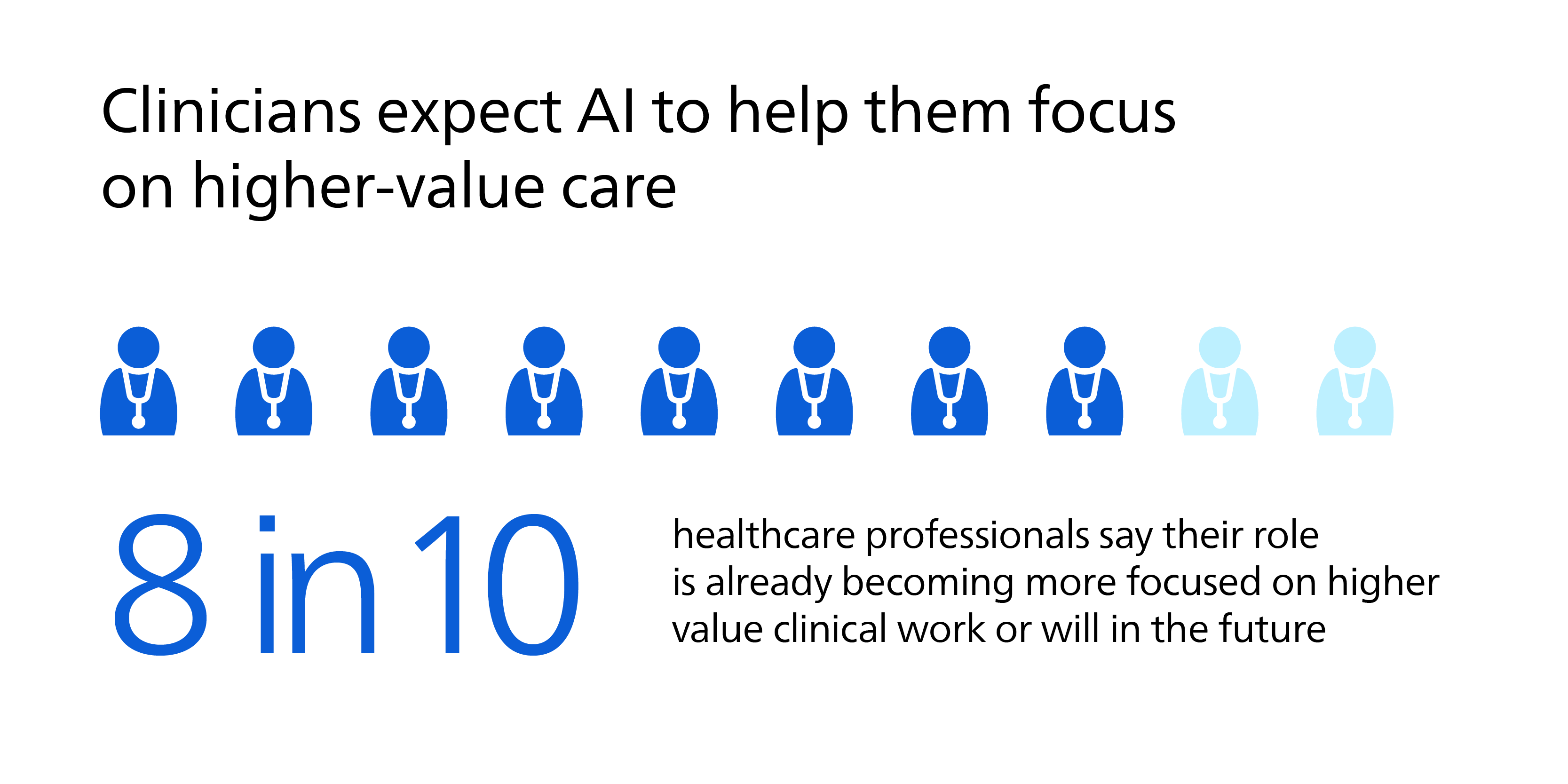
AI can help clinicians spend more time on work where their expertise matters most. Eight in 10 healthcare professionals say their role is already becoming more focused on higher-value clinical work or will in the future. That’s the better way to think about AI in the care team. The opportunity that AI presents isn’t replacing clinicians, but enabling them to work at the top of their capabilities. Some AI teammates will take on administrative or operational work. Others may support clinical reasoning or decision-making. Patients are becoming more active participants too, and in this year’s survey more than half told us that knowing how to use AI will become important for managing their health. Just as patients once arrived at their appointments with information from online searches, they’re now arriving with information from generative AI. Done well, this can help patients feel more informed, ask better questions and participate more meaningfully in their care. That’s the hybrid care team we need to design for: AI working in the background, clinicians working at the top of their capabilities and patients taking a more active role – with human judgment and relationships at the heart of care.
Move from AI in practice to AI at scale
The hybrid care team can help health systems address a core challenge: making care more accessible when demand is rising and workforces are stretched. We’re already starting to see that potential. Half of clinicians say AI has increased their capacity to see more patients, and among those clinicians, the median increase is eight additional patients per week globally. That’s a meaningful signal of what’s possible when AI is embedded effectively into care delivery. Now comes the hardest part: making those gains consistent, trusted and scalable. That means building integrated AI ecosystems, developing workforce confidence and capability and designing for the hybrid care team. If we do that well, AI can help clinicians in the moments that matter most – helping them make better decisions, build stronger relationships and deliver better care for more people.
Download the full 2026 Future Health Index report.
Share this page with your network