Scaling care to billions: AI in treatment and the race against time
Nov 24, 2026 | 5 minute read

About the author About the author
Atul Gupta, MD is Chief Medical Officer at Philips’ Image Guided Therapy and a practicing interventional radiologist. Prior to joining Philips in 2016, Atul served on Philips’ International Medical Advisory Board for more than 10 years. Atul continues to perform both interventional and diagnostic radiology in suburban Philadelphia, in both hospital and office-based lab settings. He has been repeatedly recognized as top physician for his specialty in the media and serves on several advisory boards. He has also published and lectured internationally on a range of interventional procedures.

You are about to visit a Philips global content page
ContinueAt a glance
Believe it or not, AI is already being used in your healthcare. It’s in CT scans, ultrasound and MRIs, helping doctors find disease and get you answers sooner. And now, it’s helping us treat disease, too.
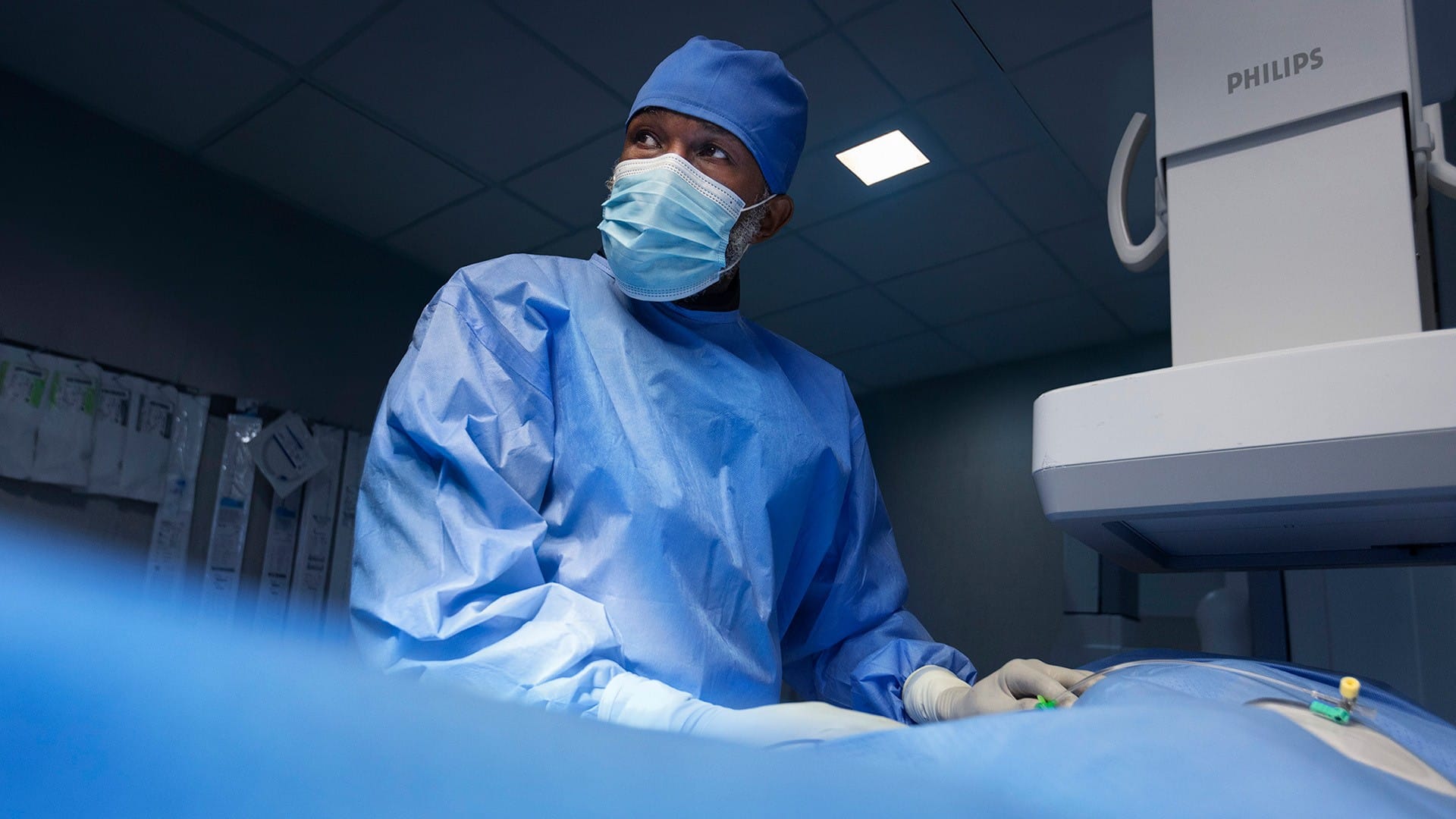
For an interventional radiologist like me, that’s an exciting development. My work involves using live images to guide tiny instruments through the body to where treatment is needed. We call it image-guided therapy, and AI is giving us new ways to see what we’re doing during these delicate procedures. Earlier in my career, a busy day might mean treating seven or eight patients. I still see patients today, and I know how much getting the right treatment can mean to someone and their family. But I also think about the people who never make it to a specialist in time, or who live too far away to access the care they need. Could we bring more of that expertise to them? That’s where advances in AI, remote collaboration and robotics become so exciting. Let’s start with what’s already possible inside a beating heart.
Bionic vision inside your beating heart
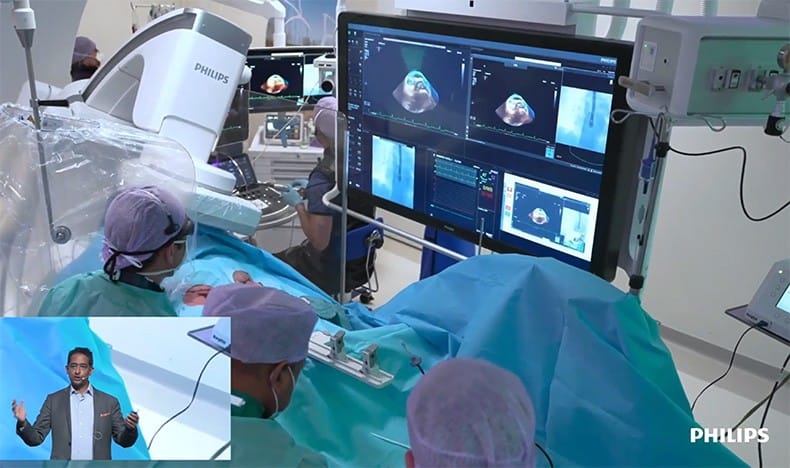
If you have a leaking heart valve, you may be short of breath, exhausted, struggling to walk upstairs. For some patients, especially elderly patients, open-heart surgery is simply too risky. Instead, interventional physicians can repair certain valves through a tiny incision in your thigh. We use catheters to guide miniature devices through the blood vessels and into your beating heart. And thanks to AI, we can see a 3D model of our instruments in real time, superimposed on live images. It’s like bionic vision: an extra pair of eyes, all while keeping the doctors completely in control. But these procedures depend on highly skilled people. What if their expertise could reach beyond the hospital where they happen to be?
What if we could teleport in expert care?
Now imagine if we take those experts and extend their reach using augmented reality. Wearing an AR headset, I could virtually stand next to a clinician maybe thousands of miles away, like in Kenya, or a remote part of the US, wherever care is needed. I could see what they see, talk them through the next step, maybe even help guide them through a procedure, all without being in the room. For you as the patient, that could mean your doctor has an experienced colleague alongside them when they need advice. The expertise could come to your hospital, instead of you having to travel to it.
Getting expertise to the people who need it, when they need it, that’s the challenge. And nowhere is that challenge more urgent than in stroke.
AI in stroke care: when time is brain
Imagine having a stroke hundreds of miles from the specialist who could save your life. There is a treatment that might help, but getting there takes time. And when a clot blocks a major artery supplying your brain, you can lose around two million neurons every minute it goes untreated [1]. That’s why doctors like me say: time is brain. To remove that tiny clot, we can guide a catheter through the blood vessels and restore blood flow; it’s a process called mechanical thrombectomy. The faster it’s performed, the better your chance of recovery. But the clock is ticking throughout the journey. As the patient, you need a scan, which someone has to assess. Then an entire team of specialists needs the information to decide what to do and prepare for treatment, sometimes at another hospital. AI can help shave time. Help teams act much sooner. It can analyze thousands of CT images in minutes – something that might have taken over an hour to do in the past – and give a summary of key findings related to stroke. Is there a bleed? Is there an infarction, where brain tissue has died due to lack of oxygen and blood supply? Is a clot blocking one of the major arteries supplying the brain? This is critical, time-sensitive information that tells us if you're eligible for thrombectomy. And it can help coordinate care too, by instantly sharing those findings with your stroke team in a private network, so everyone’s in the loop, whether it’s noon on a Monday or 3am on a Sunday morning. While you’re travelling, the team at the other end can already be reviewing your case and preparing for treatment. But that journey could take a long time. More than half of Americans live over an hour from a hospital capable of performing a thrombectomy [2]. In Australia, the distances are even more staggering; on a recent trip over there, I met Dr. Hal Rice, who leads neurointerventions at the Gold Coast University Hospital. He told me his team receives patients from as far as 2,000 kilometers away (or about 1,200 miles), on journeys that can often take more than half a day. When it comes to health outcomes, your postcode can be more important than your genetic code. It really shouldn’t be that way. So, what if you didn’t have to make that journey at all?
The next frontier: remote robotic stroke treatment
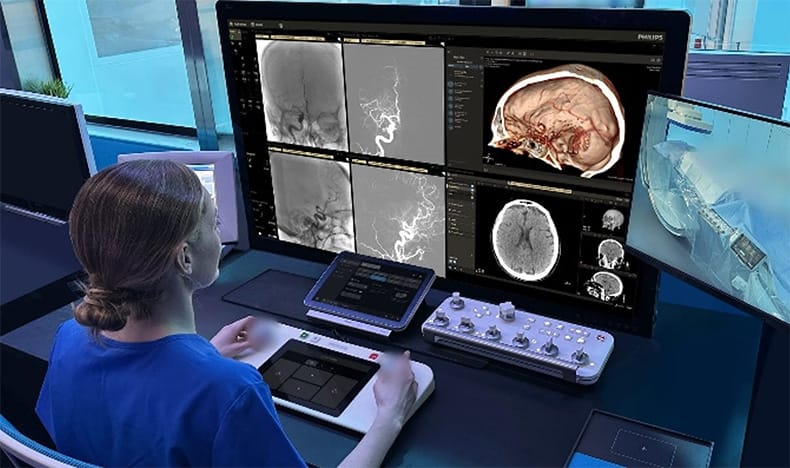
For decades, we’ve built expertise inside hospitals and asked patients to come to it. Remote robotics could let us bring the specialist to you. They could be hundreds of miles away, watching live images of the blood vessels inside your brain and controlling a robot beside your hospital bed. As they move the controls, the robot guides instruments through your vessels to remove the clot. Your local team cares for you throughout. It may sound futuristic, but earlier this year, a doctor performed a robotic thrombectomy from 120 miles away as part of an investigational procedure. What gets me excited is where this could lead. For example, Dr. Rice could finish treating a patient in his own hospital, then use the same console to treat someone on the other side of Australia. It means that his expertise could help care for people who might otherwise spend vital hours being transferred to him. Imagine robotics effectively turning him into five Hal Rices. We can’t put a specialist in every town, but we could give more towns access to one. Where could AI take this next? Researchers, including here at Philips, are exploring how it could help interpret the live images and guide the instruments through blood vessels. Eventually, a robotic system might carry out some repetitive steps automatically, under clinical supervision, with the specialist taking control for the most demanding parts. Dr. Rice described what that could mean for his team: more patients treated, and less fatigue for the doctors caring for them. When I think about the future of AI in treatment, I think about the person waiting for care. Could we get them help sooner, or make a treatment available that was previously out of reach? That’s ultimately the ambition behind scaling care to billions, and why I can’t wait to see what comes next. The views expressed are those of the author and do not necessarily reflect the official position of Philips. This article is for general information only and is not medical advice. Some technologies described are under development and may not be cleared or available in all markets; future use is subject to regulatory requirements.
References: [1] Saver JL. “Time is brain - quantified.” Stroke. 2006;37(1):263–266. PubMed record · DOI: 10.1161/01.STR.0000196957.55928.ab
[2] ARPA-H. Autonomous Interventions and Robotics (AIR) Program. Available at: https://arpa-h.gov/explore-funding/programs/air
Share this page with your network