How AI is helping improve diagnosis in prostate cancer, Alzheimer’s disease and heart disease
Nov 02, 2026 | 5 minute read

About the author About the author
Atul Gupta, MD is Chief Medical Officer at Philips’ Image Guided Therapy and a practicing interventional radiologist. Prior to joining Philips in 2016, Atul served on Philips’ International Medical Advisory Board for more than 10 years. Atul continues to perform both interventional and diagnostic radiology in suburban Philadelphia, in both hospital and office-based lab settings. He has been repeatedly recognized as top physician for his specialty in the media and serves on several advisory boards. He has also published and lectured internationally on a range of interventional procedures.

You are about to visit a Philips global content page
ContinueAt a glance
For patients, sometimes the scariest part of a health check-up is the uncertainty. It could be a blood test that comes back high, or a scan that’s delayed. You know something might be wrong, but you don’t yet know what it means for the rest of your life.
As an interventional radiologist, I know how much those answers matter. AI has all kinds of uses in healthcare, from reducing administrative burden to supporting treatment, but it all starts with understanding what’s happening inside the body. Here, I’d like to look at three examples of how AI is helping us do exactly that:
A more personalized approach to prostate cancer care
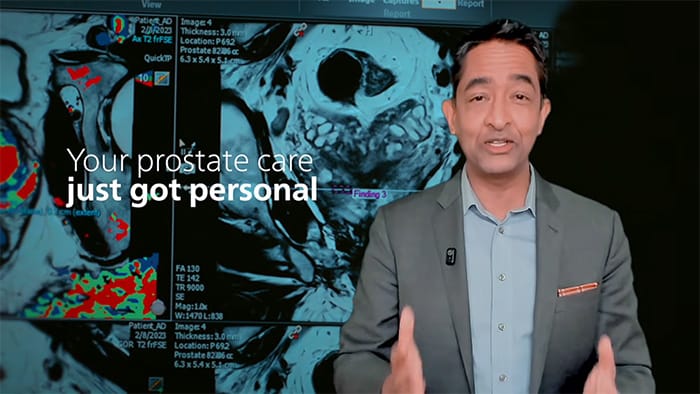
Take prostate cancer: most of us know someone who’s faced it before. Some prostate cancers grow so slowly that they may never threaten a man’s life. The challenge is identifying the cancers that need treatment without subjecting everyone else to unnecessary procedures and anxiety. The standard screening process, starting with the PSA blood test (which checks the level of prostate specific antigen in your blood), is notoriously flawed. The test frequently gives false positives, triggering immense anxiety in patients. If it came back high, the standard approach is a blind biopsy. It’s invasive, it can be imprecise, and it causes huge anxiety [1]. Wouldn’t it be better to have a care path that’s actually built around you? Today, we’re starting to do just that. MRI can give doctors a clearer view before they decide whether a biopsy is needed. By integrating AI into the MRI workflow, we can help radiologists spot suspicious areas in the prostate. The doctor considers those findings alongside the patient’s overall risk. For some men, that can mean hearing: "No biopsy needed." It’s a huge weight off someone’s shoulders. But let’s say the MRI showed a suspicious nodule. Then what? Today, we can fuse the MRI images with the live ultrasound, enabling the clinician to target that area when taking a tissue sample. And AI support doesn’t stop at the scan. Digital pathology allows remote specialists to assess tissue samples, and AI can help pathologists analyze the images. Together, these capabilities can help speed up diagnosis and ease the strain on local, understaffed pathology departments. That’s the direction of AI in prostate cancer: helping us identify who needs treatment, who doesn’t, and what the best next step might be.
Prostate cancer is one example of how AI is helping clinicians uncover information that might otherwise be missed. The same principle is transforming care in another area where getting the right diagnosis can make a profound difference: Alzheimer’s disease.
New hope for Alzheimer’s patients
Every five seconds, someone is diagnosed with Alzheimer’s – it’s the most common cause of dementia. Think about the human cost. Maybe it’s a parent, or a spouse, having to face up to the reality that they’re slowly losing their precious independence, and their precious memories. If you’ve ever cared for someone with the disease, you know just how much of a toll it takes on a family. But there is hope. Recently, treatment for the disease took a huge leap forward. Drugs that finally target the cause of Alzheimer’s, not just the symptoms, are being approved all across the world. They’re called monoclonal antibody drugs, and they break down the amyloid protein deposits in the brain, which can slow cognitive decline in some people with early Alzheimer’s. These medicines won’t cure the disease, but they offer the possibility of more time living independently, and more time with the people they love. That makes getting a timely, accurate diagnosis particularly important. MRI is part of that assessment. AI can automatically analyze brain MRI scans to help radiologists understand changes in different regions of the brain and support doctors as they distinguish between types of dementia. The scan contributes to a broader assessment of whether a patient might be eligible for treatment. But the new drugs bring with them a new challenge. They can cause brain swelling or tiny bleeds, known as ARIA, or amyloid-related imaging abnormalities, which means patients need regular MRI monitoring, and those findings can be notoriously difficult for radiologists to interpret. This is where AI can become another valuable set of eyes. It can highlight suspected ARIA findings and measure their extent, supporting clinicians as they monitor for complications. Meanwhile, AI-enabled MRI can scan up to three times faster than traditional MRs, helping hospitals respond to the additional demand. Helping us radiologists keep a close watch as treatment continues. And helping to put hope back on the horizon for people living with Alzheimer’s disease and the families who love them.

But diagnosis isn’t the end of the story. What if AI could help us identify problems before symptoms even begin?
Heart disease: from diagnosis to prediction
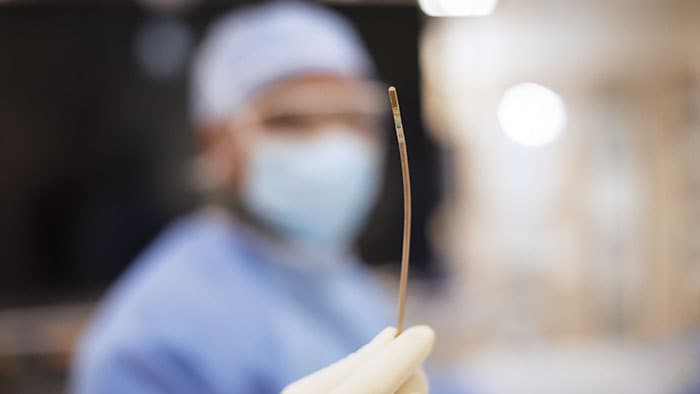
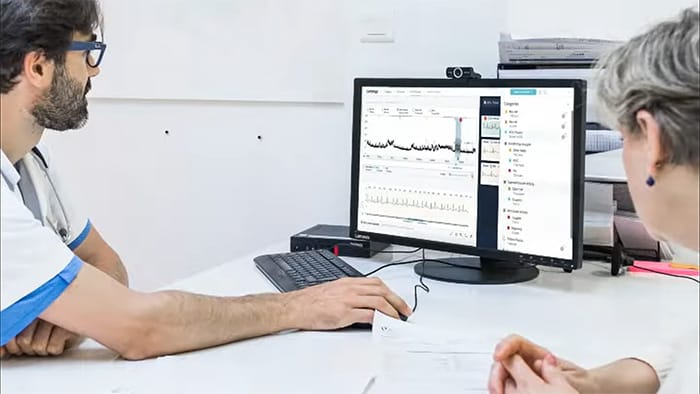
Atrial fibrillation, or AFib, is when our heart beats irregularly and very fast. Left untreated, it can increase the risk of stroke. The trouble is, the symptoms can come and go, and you may not even know you have it [2]. That’s where AI-enabled monitoring comes in. Patients can now wear a tiny patch on their chest which monitors the heart’s electrical activity for up to two weeks. AI-powered software then helps clinicians analyze the recordings for abnormal rhythms, including AFib, reviewing every heartbeat and highlighting the findings that matter most. Built on more than 200 million ECG recordings, the technology can identify more than 20 different types of cardiac events, helping clinicians make sense of vast amounts of data that would otherwise take hours to review. At Frimley Health NHS Foundation Trust in the UK, ePatch is used with Cardiologs AI analysis. The trust reported clinics seeing around 30 patients a day, compared with a previous maximum of about 14, alongside faster reporting and getting results back to patients sooner [3]. What excites me even more is where this could lead next. In research presented in 2026, involving more than 11,000 patients, AI helped identify people at greater risk of a future stroke or a blood clot blocking an artery elsewhere in the body, even though their heart recordings showed no AFib [4]. Think about that. The recording hasn’t captured an episode, but AI may already be picking up signals that tell us someone is at greater risk. We’re beginning to see what might lie ahead. The earlier we can identify risk, the earlier we have the opportunity to intervene. To me, that’s pretty incredible.
Getting more people back to living the lives they love
What excites me about these developments is what they mean for the person waiting for an answer. Whether it’s prostate cancer, Alzheimer’s disease, heart disease or stroke, AI-powered diagnosis is helping us understand what’s happening sooner and choose the best path forward. For some patients, that may mean starting treatment earlier or avoiding procedures they don’t need. Either way, it means that patients get answers sooner. And ultimately, that’s what matters most: getting more people, in more places, back to living the lives they love.
References: [1] National Cancer Institute. Prostate-Specific Antigen (PSA) Test. Information on PSA testing, false positives, overdiagnosis, and limitations of PSA screening. Available at: https://www.cancer.gov/types/prostate/psa-fact-sheet [4] Proudhon T et al. Prediction of atrial fibrillation using deep learning from a single-lead sinus rhythm electrocardiogram is associated with future ischemic stroke or systemic embolism. European Stroke Journal. May 2026;11(Supplement_1):i49. Conference abstract ESOC2026A1157. https://doi.org/10.1093/esj/aakag023.078.
[2] Centers for Disease Control and Prevention (CDC). About Atrial Fibrillation. Information on atrial fibrillation, symptoms, risk factors, and stroke risk. Available at: https://www.cdc.gov/heart-disease/about/atrial-fibrillation.html
[3] Frimley Health NHS Foundation Trust. Heart patients benefit from wearable tech in NHS first. Case study on implementation of Philips ePatch and Cardiologs AI analysis. Available at: https://www.fhft.nhs.uk/news/heart-patients-benefit-wearable-tech-nhs-first
Share this page with your network